


Editor’s Note: The writer, Debbie Schwartz, is the founder of Road2College.
“Is an honors college worth it?” is the wrong question, or at least an incomplete one. The better question is specific to each school: what would your student actually miss without it? At some colleges, it unlocks perks that every student already gets. At others, it’s the only door to small classes, research funding, and priority registration.
Answered that way, the decision becomes much clearer. I explored this in a recent Road2College webinar with Terry Cowdrey, an enrollment management consultant who has led admissions and financial aid at Colby College, St. Lawrence University, and Muhlenberg College.
Here’s what an honors college can add for your student, what it asks in return, and how to find out which is which at any given school.
What an Honors College Actually Gives Your Student
An honors college bundles together the perks colleges usually reserve for their strongest students: smaller classes, a built-in community, priority registration, research money, and closer faculty access. Whether it’s worth it depends on how many of those your student would miss without it.
The benefits Cowdrey highlighted show up again and again across schools:
- Smaller classes taught by professors. At a large university, an intro course can hold 200 or 300 students, often with discussion sections run by graduate students. Honors classes are small, and it’s usually the professor teaching them directly.
- A built-in community. Many honors colleges include honors housing, at least for the first year or two, plus dedicated events. It’s a fast way for your student to find like-minded peers inside a big school.
- Priority class registration. Early access to registration matters most at high-enrollment schools, where regular students, especially first-years and sophomores, may not get their top course choices.
- Research funding and internships. Cowdrey, who spent 14 years at St. Lawrence University in upstate New York, pointed to its summer research program: about 40 students spend eight weeks doing research with a faculty member, earning $4,500 with housing paid. These opportunities aren’t limited to the sciences, and honors students often get first access.
- Enhanced advising. Honors students frequently get a second advisor on top of their major advisor, and that advising often points them toward national fellowships like the Rhodes, Fulbright, and Goldwater.
- Scholarship money. Admission to an honors college often comes with a scholarship attached, which can make the net cost meaningfully lower, especially for families who won’t qualify for much need-based aid.
Here’s the catch that turns this into a real decision: at some colleges, every student can be mentored by faculty, do research, and take small classes. So the question isn’t whether these perks are good. It’s which of them are honors-only at the specific schools on your student’s list.
Honors College vs. Honors Program: Don’t Get Hung Up on the Label
An honors college and an honors program offer similar benefits; the main difference is usually residential. An honors college, more common at large universities, often brings students together to live in honors housing their first year or two. An honors program, more common at smaller colleges, may not.
As Cowdrey put it, the two terms are almost interchangeable, and it’s not worth getting hung up on which one a school uses. What matters is what the program actually offers your student, not what it’s called.
For further reading, here’s our look at the best honors colleges and programs.
Trade-Offs to Weigh Before Saying Yes to Honors College
An honors college asks something in return. There’s more to apply for, more to maintain, and sometimes a real tension with grades. None of it is a dealbreaker, but you want to know what your student is taking on.
On the way in, honors often means extra work: additional essays, references, sometimes a required test score even at a test-optional school, and earlier deadlines. At the University of Georgia, for example, applying by October 15 lets a student skip an extra essay that’s required later. Once in, it’s a four-year commitment. Many programs require a minimum GPA to stay enrolled, and the most common one Cowdrey saw was a 3.4 cumulative. Some require honors housing the first year, some require a senior thesis, and all expect active participation.
The trade-off worth the most thought is grades. Honors courses can be harder, which matters if your student is aiming at law, medical, or business school, where the graduating GPA carries real weight.
Cowdrey’s take: the faculty relationships and research access that come with honors are “another arrow in the quiver” for graduate applications, often through stronger recommendation letters. A student who turns down honors needs to be especially committed to maintaining a high GPA, because they won’t have those enrichment opportunities. And at many schools, a student can start in honors and ask to step out later if it’s hurting their GPA.
One more reality check: honors isn’t for everyone. At many schools, only about 10% of students are in it, and the other 90% still get an excellent education. If your student has no interest in undergraduate research, that’s a perfectly fine reason to skip it.
How to Find Out What’s Honors-Only at Each School
Because the answer changes by college, you have to research each one. College websites are the most comprehensive, up-to-date source, but the most useful information often comes from asking the admissions office directly.
Admissions structures vary. Some schools want extra essays and an earlier deadline when you apply. Others automatically consider every admitted student and invite the strongest afterward. Still others invite certain students to apply for honors. Some even let students apply during their first year and join as sophomores, so a student who isn’t invited up front isn’t necessarily shut out. When a school doesn’t invite a student directly, there’s sometimes a petition process involving an essay and references.
The questions to ask are the ones that get at your student’s actual experience: What’s available only to honors students versus everyone? Could you connect me with a current first-year or sophomore in the program?
One frustration Cowdrey and I both flagged is that the data families most want, the average GPA and test scores of admitted honors students, is rarely published; Georgia is a standout exception. That’s exactly the kind of comparison worth doing before your student commits.
Compare Your Student’s Options With Our College Comparison Report
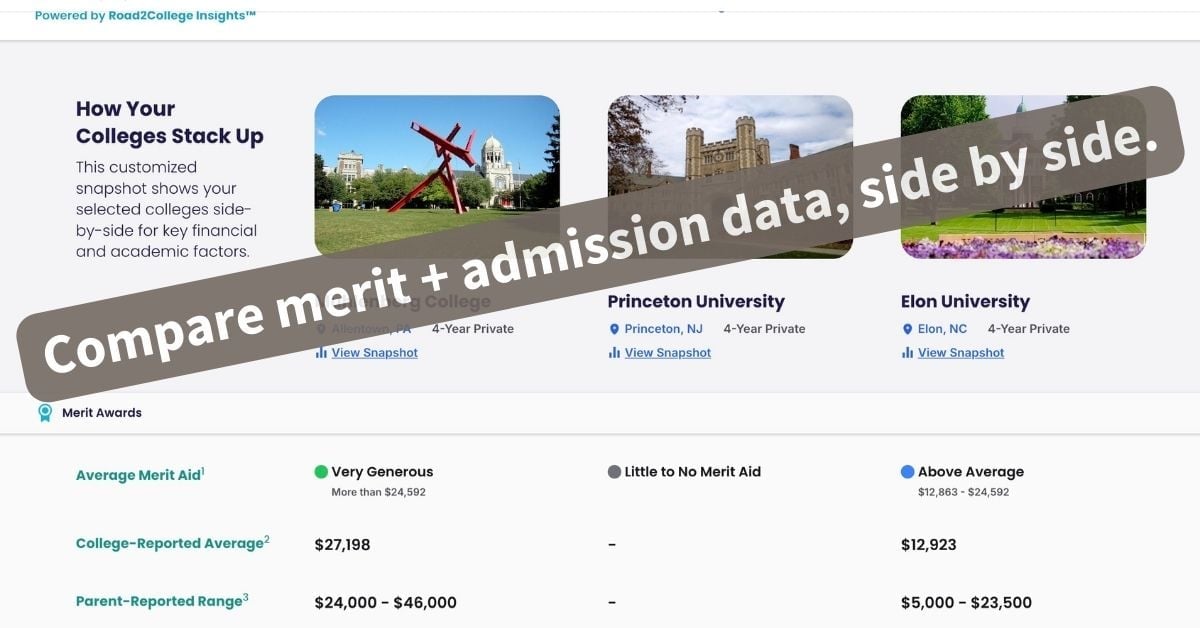
Honors decisions often come down to weighing very different offers, like a large private university with no honors track against a public honors college where your student would get small classes and priority everything. Our College Comparison Report lines up the schools on your student’s list side by side, so you can see how they stack up before making the call.
Looking for expert help on the road to college? See our 1-to-1 coaching services.