


The 2027–28 FAFSA is open now, with real-time results and text-message invites. This guide covers what’s new, how to fill out each section, what counts as an asset, and the mistakes that delay aid.
Inside This Article:
- What’s new on the 2027-28 FAFSA
- Step-by-step instructions on filling out the 2027-28 FAFSA
- What counts as an asset
- Common FAFSA mistakes to avoid
- FAFSA deadlines
- Who fills out the FAFSA?
- FAFSA FAQ
Quick Summary:
The 2027–28 FAFSA is open now and uses 2025 tax information. New this year: results arrive in real time, students can invite a parent by text, and every form is screened for identity fraud, so keep a photo ID handy. The biggest mistakes happen in the asset questions, where families report retirement accounts, home equity, and family businesses the formula never asks for. For divorced parents, the one who files is whoever provides more financial support. The federal deadline is June 30, 2028, but state and college priority deadlines come months earlier.
FAFSA Changes for the 2027-28 Cycle
The 2027–28 FAFSA uses 2025 tax information and delivers results in real time, so most applicants see their Student Aid Index within minutes. Two sections have new names, contributors can now be invited by text, and every form is screened for identity fraud.
Here’s what’s new for 2027–28:
- The Department of Education says the form now takes as little as 15 minutes to complete.
- Most forms are processed in real time. Your FAFSA Submission Summary, including your Student Aid Index (SAI), is ready as soon as the form is submitted, though some forms still take one to three days.
- Students can scan a QR code to send a parent or spouse a text message inviting them to the form. Email invitations still work.
- The “Personal Circumstances” section is now called “Background,” and “Signature” is now “Review and Sign,” with reviewing and signing on a single page.
- Questions about college plans, homelessness, and high school completion have been reworded to make them easier to understand.
- Each contributor is asked whether they filed a 2025 tax return in Puerto Rico or another U.S. territory. Contributors report combined income and taxes paid if they filed both a U.S. return and a territory return.
- Every submitted form is screened for fraud. A small number of applicants are asked to verify their identity with a government-issued photo ID.
- Renewal forms pre-filled with a returning student’s previous answers are coming later this fall. They aren’t available yet, so returning students fill out the form again for now.
Last year’s updates also remain in place. Students can invite a parent or spouse by email without entering that person’s Social Security number or date of birth, and new StudentAid.gov accounts linked to a Social Security number are verified instantly. Families still don’t report the net worth of family-owned businesses with 100 or fewer full-time or full-time equivalent employees, farms they live on, or family-owned commercial fishing businesses. The Pell Grant calculation still adds any foreign income exclusion to adjusted gross income (AGI), and a student still can’t get a Pell Grant if their SAI is at least twice the maximum award, with limited exceptions.
Now that you know what’s new, here’s a refresher on how the FAFSA works and who should complete it, followed by a walkthrough with college financial planning specialist Luanne Lee, who partners with Road2College.
How Does FAFSA Work?
The Free Application for Federal Student Aid (FAFSA) is the federal form colleges use to determine eligibility for financial aid, including grants, scholarships, work-study, and federal student loans. Each year, students and parents share income and asset information so schools can calculate how much need-based aid the student qualifies for.
After you submit your FAFSA, the Department of Education calculates your Student Aid Index (SAI) and sends the results to the colleges you list on the form. Each college then uses your SAI, along with its own cost of attendance, to build your individual aid offer.
The biggest thing to remember is that the FAFSA is the gateway to many different forms of financial aid, and every student should submit it, whether or not they expect to qualify for need-based help. These aid types include:
- Federal grants (e.g., the Pell Grant)
- Federal work-study programs
- Federal student loans
- State scholarships
- Need-based aid and some merit scholarships from colleges and universities
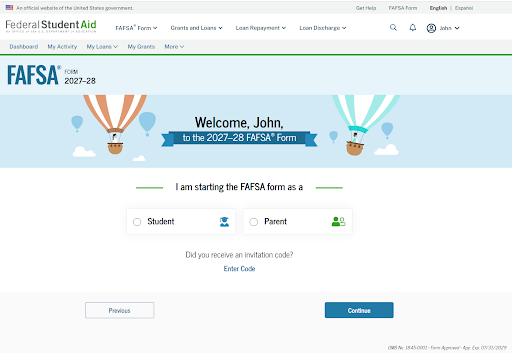
The 2027–28 FAFSA starting screen from the U.S. Department of Education.
Ready to get started? Here’s how to prepare for and complete the 2027–28 FAFSA, and how to avoid common mistakes.
Instructions on How to Fill Out the 2027-28 FAFSA
The Department of Education says the 2027–28 form takes as little as 15 minutes if you gather everything you need first. The process has six steps: set up accounts, gather documents, complete the form, review and sign, check your processing status, and read your FAFSA Submission Summary.
Luanne Lee walks through every screen of the 2027–28 FAFSA in our annual Road2College FAFSA webinar. The written steps below follow the same order, with links to the matching moments in the video.
Step 1: Create (or Confirm) Your StudentAid.gov Account
Each contributor, whether student, parent, or spouse, needs their own StudentAid.gov account to fill out and sign their part of the FAFSA. Accounts linked to a Social Security number are verified instantly. Contributors without an SSN can create an account through an alternate identity-verification process.
Use a personal email address rather than a high school or work address. The account is tied to your Social Security number and follows you for years, especially if you or your student borrow. Your username and password are your legal signature on the form, so write down the case-sensitive password and save the backup code you’re given during setup.
If you already have an account from your own student loans or from filing a FAFSA years ago, that account is still yours. Use the forgot-password link rather than creating a second one. If you already have an account, log in and confirm your StudentAid.gov information is current, especially your email and mailing address. (This is still sometimes called your FSA ID.)
▶ Watch Luanne set up a StudentAid.gov account (26:33)
Step 2: Gather Your Information
Before you start, gather 2025 tax returns and W-2s, Social Security numbers, records of untaxed income, current account balances, an email address for each contributor, and a government-issued photo ID in case your form is flagged for identity verification. Plan to file in one sitting.
Collect these details for both student and parent:
- 2025 tax returns and W-2s (the FAFSA uses prior-prior-year tax data)
- Social Security numbers (if applicable)
- A driver’s license, passport, state ID, or green card for the student and the filing parent
- Records of untaxed income, such as child support received or veteran benefits
- Current balances of savings, checking, investments, and other real estate
- Email address for each contributor
- List of up to 20 colleges to receive your FAFSA data
Gathering all of it first matters more than it used to, because logging in and out mid-form invites errors. “This will literally take you maybe 30 minutes if you read the directions,” Lee told our webinar audience. “20 minutes if you don’t.”
You’ll need only the email address of any contributor you plan to invite. The system sends them a secure code so they can log in separately, and students can also send the invitation by text using a QR code.
▶ Watch Luanne’s pre-filing checklist (18:28)
Step 3: Start Your FAFSA
To start the 2027–28 FAFSA, log in to StudentAid.gov with your own account, choose your role, and confirm your identity information and state of residence. Then give consent to import your 2025 tax information. You can save your progress and return at any time.
Start with the student’s section. A parent can log in under their own account and start the form, but the student’s form belongs to the student, and beginning on the parent side is where families most often hit glitches they can’t undo themselves.
On StudentAid.gov, the application will ask who you are (student, parent, or preparer) and prompt you to confirm your role. The form is divided into sections, and some won’t apply to every contributor. You’ll fill out the following sections if they apply to you:
Personal Identifiers
- Your name, date of birth, Social Security number, and email
- Student (or parent) identity verification
- State of residence, including a military location if you’re stationed outside your home state
Consent
All contributors must click the consent button to allow the import of 2025 IRS tax data. The application cannot be processed until everyone gives consent. This is the screen families skip past without reading, and it’s the reason you never see income questions: the IRS sends that information directly.
If you haven’t filed your 2025 return yet, amended it, or filed jointly with someone you’re now separated from, the transfer may not work. The form will tell you, and you’ll enter income from your W-2s and 1040 line by line instead.
▶ Watch the IRS consent screen everyone skips (39:44)
Background
- Marital status
- College or career school plans
- Special family circumstances, such as homelessness
- Dependency status
One question here asks whether the student’s parents refuse to provide their information. Answer no unless that’s truly the case, because answering yes limits the student to unsubsidized loans.
Demographics
- Sex, race, and ethnicity (used for research only; answers don’t affect eligibility)
- Citizenship status
- High school completion
Your Finances
Students and parents fill out this section separately. Information from 2025 tax returns will import automatically through the IRS DDX once consent is given. Review all transferred data for accuracy and add current balances for savings, checking, and investments.
The form also asks whether you filed a 2025 tax return in Puerto Rico or another U.S. territory. You’ll report combined income and taxes paid if you filed both a U.S. return and a territory return.
The parent section adds a few questions the student doesn’t see: federal benefits received, family size, and number in college. Count the student you’re filing for plus any siblings who will be enrolled during the 2027–28 year, and don’t count yourself.
Enter exact balances rather than round numbers. Aid offices notice when every figure ends in double zeros. See what counts as an asset for the full list of what to report and what to leave out.
Select Colleges
Students can list up to 20 colleges to receive FAFSA information. You can search for each school by name or Federal School Code. List in-state public colleges first if you may qualify for state aid, since some states award from the list in order. Colleges don’t see the other schools on your list.
Invite Contributors
After selecting colleges, students invite any required contributor, such as a parent or spouse. Enter the contributor’s email address; their Social Security number and date of birth aren’t required. Students can also scan a QR code to send the contributor a text message invitation. Write down the invitation code that appears on this screen. The contributor receives a secure code and logs in with their own StudentAid.gov account to complete their portion.
▶ Watch the student invite a parent (48:32)
Stuck on a question? Ask in Road2College’s free Paying for College 101 Facebook group, where more than 300,000 parents and experts trade advice, or call the Federal Student Aid Information Center at 1-800-433-3243.
Step 4: Review and Sign Your FAFSA
Each contributor reviews their answers and signs electronically through their own StudentAid.gov account. For 2027–28, reviewing and signing happen together on a single page. The FAFSA is submitted once the last required contributor signs, so a student’s form isn’t complete until every contributor finishes.
Accounts linked to an SSN are verified instantly, so a contributor who still needs an account can create one and sign on the same day.
Step 5: Check Your FAFSA Processing Status
The Department of Education now processes most FAFSA forms in real time. After the last contributor signs, a confirmation page shows whether your results are ready. Some forms still take one to three days, and you’ll receive an email when yours has been processed.
If your results are ready, the confirmation page will prompt you to open your FAFSA Submission Summary.
Every FAFSA is also screened for fraud as it’s submitted, and a small number of applicants flagged by that screening are asked to verify identity before the form finishes processing. If that screen appears, you’ll enter a cell phone number, scan a texted QR code, photograph a driver’s license, passport, state ID, or green card, and take a selfie. It takes about three minutes if the ID is in hand. A birth certificate won’t work.
This is the part of the process Lee expects to trip families up. “This is going to be the stickler for the year, I think,” she said during our webinar.
If your student doesn’t have an acceptable ID yet, let the form process anyway. It still goes to your colleges. Once your student chooses a school, contact that college’s financial aid office and ask what it needs to verify identity, rather than working through all 20 schools on your list.
▶ Watch the identity verification screens (50:23)
Step 6: Get Your FAFSA Submission Summary
Your FAFSA Submission Summary (FSS) shows your Student Aid Index (SAI) and your estimated eligibility for federal student aid. Review it carefully. If anything needs fixing, you can submit a correction on StudentAid.gov, and your first four corrections are processed immediately. Later corrections take about 24 hours.
The summary isn’t emailed to you. Your student logs in at StudentAid.gov and opens it from the form details page, where the Actions menu also holds Add or Remove Schools and Make Corrections. Jot down the four-digit data release number on the summary. If a college says it never received your FAFSA, that number usually finds it.
The SAI can still be a negative number, with a minimum of –1,500, and the number of family members in college is still excluded from the formula. An SAI between 0 and –1,500 qualifies a student for the maximum Pell Grant, which is $7,395 for 2026–27. The Department of Education will announce the 2027–28 maximum in early 2027.
▶ Watch Luanne find your SAI and submission summary (1:05:12)
Since 2026–27, the Department of Education has added any foreign income exclusion amount to adjusted gross income (AGI) when determining Pell Grant eligibility. This rule may change the aid estimate for some families but does not affect the SAI formula itself.
If you’re a first-year undergraduate, your FSS may also include a yellow notice saying some of your selected schools show lower earnings. A college gets flagged when its graduates typically earn less than high school graduates in its state (or nationally, for colleges that mainly enroll out-of-state students), based on College Scorecard data. Select the notice to see median earnings for every college on your list.
If your student applies to more than 20 colleges, wait three to five business days after your results come back before swapping the list. Delete all 20 at once, add the remaining schools together, and sign again. Adding them one at a time invites errors.
Colleges automatically receive your updated Student Aid Index once the Department finishes processing, so you don’t need to send anything separately.
▶ Watch how to swap colleges after you file (1:10:17)
What Counts as an Asset on the FAFSA?
The FAFSA asks for the value of your accounts on the day you file, not on your tax return. Report cash, savings, checking, brokerage accounts, CDs, and other real estate. Leave out retirement accounts, the home you live in, and qualifying family businesses and farms.
“This is where people make the biggest mistakes in overstating their assets,” Lee said. Families routinely report money the formula never asks for, and every dollar they add raises their SAI.
▶ Watch Luanne go through assets line by line (20:34)
Assets You Don’t Report
Retirement accounts don’t count on the FAFSA, and neither does the home you live in. The form also skips the cash value of life insurance, qualified annuities, and, since 2026–27, qualifying family businesses, farms, and commercial fishing businesses. Leave all of it off the form.
- Qualified retirement accounts: 401(k), 403(b), TSP, SEP, SIMPLE, and traditional and Roth IRAs
- Cash value inside life insurance contracts and qualified annuities
- Equity in the home you live in, including a home equity line of credit on it
- A family-owned business your family owns more than half of, with 100 or fewer full-time or full-time equivalent employees
- A family farm you live on and work
- A family-owned commercial fishing business
- 529 accounts owned by grandparents or anyone else outside the household, and 529 accounts designated for your other children
- Debt on its own. The form asks for the value of what you own, not what you owe.
Calling an account your retirement savings doesn’t exempt it. If it isn’t a qualified retirement plan, it gets reported.
▶ Watch the small business and family farm rules (23:14)
Assets You Do Report
Report what’s in your accounts the day you file, not what was there at tax time. That includes cash, checking, savings, CDs, high-yield savings, savings bonds, brokerage accounts, mutual funds, and real estate other than the home you live in.
- Checking, savings, CDs, high-yield savings, and savings bonds, at their balance the day you file
- Brokerage accounts, mutual funds, and non-qualified annuities
- Real estate other than your home, at its value minus the mortgage and any line of credit on it
- The 529 for the student you’re filing for, reported as a parent asset even when the student owns it
- UTMA and UGMA accounts, reported as the student’s assets
- Trusts the student or a parent benefits from, whether revocable or irrevocable
- Your share of a business with outside owners
- Accounts you co-own with someone else, including a parent’s account you were added to. Being a signer is different from being an owner.
Balances move, and the FAFSA takes a snapshot. If your brokerage account drops the week after you file, you can’t go back and change it.
▶ Watch the grandparent 529 answer (1:18:14)
How Much Do Assets Count?
Whose name an asset is in matters. Student assets count at 20%. Parent assets are reduced by an allowance, converted at 12%, then assessed on a scale that tops out at 47%, so parent assets raise your Student Aid Index by no more than 5.64% of their value.
That gap is why the timing of ordinary financial moves matters. A student with earned income can move savings into a Roth IRA before filing, and the money leaves the 20% column. A UTMA or UGMA account can be converted into a custodial 529, titled the same way with the child as owner and beneficiary, which is reported as a parent asset instead. What you can’t do is move custodial money into a parent’s own account. It legally belongs to the child and has to be spent for the child’s benefit.
▶ Watch the UTMA and UGMA answer (1:40:37)
Who Can Skip the Asset Questions?
Some families never see the asset questions. The FAFSA skips them if your AGI is under $60,000 and you don’t file Schedules A, B, D, E, F, or H, or if someone in the family received a means-tested federal benefit in either 2025 or 2026.
A Schedule C is fine if the net business income is no more than a $10,000 gain or loss. One caution on the federal benefits list: don’t check free or reduced-price school lunch just because your district feeds every student. Check it only if your income actually qualifies your family for that benefit.
Common FAFSA Mistakes to Avoid
FAFSA mistakes can delay your aid or reduce it. The ones below are easy to avoid: listing the wrong parent, reporting assets that don’t count, rounding your balances, leaving the form unsigned, filing the wrong year’s form, listing too few colleges, and paying to file.
- Listing the wrong parent. If the student’s parents are divorced or separated, the contributor is the parent who provides more financial support, even if the student lives with the other parent most of the time.
- Reporting assets that don’t count. Leave out retirement accounts, the home you live in, qualifying family businesses, farms you live on, and family-owned commercial fishing businesses.
- Rounding your balances. Enter the actual amount in each account, even if it’s $17 in a Venmo balance.
- Answering yes to the parent refusal question. Some students check it because their parents can’t afford to help, which isn’t what it means. It limits the student to unsubsidized loans.
- Leaving the form unsigned. The FAFSA isn’t submitted until the last required contributor signs. If a parent never finishes their section, the student’s form stays incomplete.
- Filing the wrong year’s form. Students starting college in fall 2027 need the 2027–28 FAFSA, not the 2026–27 form.
- Listing too few colleges. The online form lets you list up to 20 colleges. Include every school you’re applying to or considering.
- Paying a website to file. The official FAFSA is free on StudentAid.gov. Some websites charge fees to help with the form, and they aren’t affiliated with the Department of Education.
What to Do After You File the FAFSA
After you file, watch for each college’s aid offer, compare what you’d actually pay at each school, and plan how to cover the rest. If your family’s finances have changed since 2025, ask each college’s financial aid office about a professional judgment review.
Know your borrowing limits before you compare offers. Students can take $5,500 in federal loans as freshmen, $6,500 as sophomores, and $7,500 as juniors and seniors. As of July 1, 2026, parents are capped at $20,000 a year in Parent PLUS loans and $65,000 total per student, where borrowing was once limited only by the cost of attendance. Parents who borrowed for that student before July 1, 2026, can keep using the old limits for up to three more years.
- Compare your offers. Compare Offers lines up your aid offers side by side and shows how they stack up against offers other families have shared.
- Plan how to pay. The Borrowing Blueprint helps you map out how to cover the remaining cost, including whether and how much to borrow.
- Appeal if your situation changed. Road2College’s Financial Aid Appeal Review helps you make your case to a college’s financial aid office.
Get a Sneak Peek at Your Estimated Student Aid
The Department of Education’s Federal Student Aid Estimator gives an early, unofficial estimate of your eligibility for federal grants, work-study, and loans. Answer a few questions about your family and income to see where you might stand before you file the FAFSA.
One big caution: this is only a projection based on the information you enter. Your actual aid offer will vary once the FAFSA is processed and your Student Aid Index (SAI) is calculated. Still, the estimator is a good way to get a ballpark figure and plan ahead before completing the FAFSA.
Who Should Apply for FAFSA?
All college applicants should submit the FAFSA, even if their families have million-dollar incomes. Why? First, FAFSA is the gateway to federal student and parent loans. Second, the calculation for need-based aid may surprise you. Third, FAFSA is used for some state and college scholarships and work-study programs.
Lee, who has walked families through this form with me for 10 years, puts it plainly: “Even if you make Bill Gates kind of income, you should file the FAFSA, because you just never know.”
That’s truer now that colleges routinely pass $90,000 a year in total cost. At those prices, families with high incomes can still land in a gap that a college fills with its own aid, and no college will fill a gap it never sees.
Bottom line: Fill out the FAFSA even if you think you won’t qualify for need-based aid. Even if you think you can cover every penny alone, having all the options available can’t hurt. And you don’t have to accept any aid you qualify for. It’s your choice.
FAFSA Deadlines
The 2027–28 FAFSA is open now, and the federal deadline to submit it is June 30, 2028, at 11:59 p.m. Central Time. State and college priority deadlines come much earlier, often between December 2026 and April 2027.
| FAFSA | Available | Tax Information Used | School Year | Federal Deadline |
|---|---|---|---|---|
| 2026–27 | Since Sept. 24, 2025 | 2024 | July 1, 2026, to June 30, 2027 | June 30, 2027 |
| 2027–28 | Since Sept. 23, 2026 | 2025 | July 1, 2027, to June 30, 2028 | June 30, 2028 |
Filing in September instead of November won’t change your federal aid. Pell Grants and federal loans don’t run out, and colleges generally don’t begin reviewing FAFSA data until November. What early filing protects is state aid, since a handful of states award grants until the money is gone, and your college’s own priority deadline, which is often earlier than you expect if your student applies early decision or early action.
To find your state’s specific deadline, visit the FAFSA Deadlines page on StudentAid.gov.
Who Fills Out the FAFSA Form?
Each student must complete their own FAFSA, but they may need one or more contributors to provide financial information. A contributor is anyone whose information is required on the FAFSA, such as a parent, stepparent, or spouse. Each contributor fills out and signs their own section.
If the student’s parents are married and filed a joint 2025 tax return, only one parent needs to be a contributor, and it doesn’t matter which one. If they’re married but filed separately, both parents are contributors and both need their own accounts. Parents who never married but live together are both contributors too. For divorced or separated parents, the parent who provides more financial support fills out the FAFSA, and a stepparent’s information comes with them.
Not sure which parent that is? The Department of Education’s Who’s My FAFSA Parent? wizard walks through the possibilities in about five minutes, and you don’t need an account to use it.
▶ Watch which parent files, married, separated, or divorced (13:46)
Students invite contributors by entering their email addresses in the FAFSA form or by scanning a QR code to send a text message invitation. Each contributor receives a secure code to log in and complete their portion. The contributor’s Social Security number or date of birth is no longer required to connect accounts.
All contributors must create their own StudentAid.gov account and give consent for the IRS Direct Data Exchange (DDX) to transfer their 2025 tax information. The FAFSA cannot be processed until every contributor provides consent and signs electronically.
FAFSA Changes for Divorced Parents
Under the current FAFSA rules, the parent who provides more financial support to the student — not the parent the student lives with most — is the one who must complete the FAFSA. This change, introduced under the FAFSA Simplification Act, continues for the 2027–28 cycle.
In practice, the parent with primary custody is usually the one providing more support. As Lee explained during our webinar, “If you have primary custody, you’re likely providing more financial support because you’re providing the roof over your child’s head and food and the uniforms and all the things.” Income only settles the question when the parents provided equal support or don’t know who provided more, in which case the parent with the greater income and assets files.
Because the higher-income parent often provides the most financial support, this can result in a higher Student Aid Index (SAI) than under prior rules, when the lower-income custodial parent typically filed the FAFSA.
There’s nothing improper about understanding these rules before you decide how support is arranged. Families of divorced parents may also want to include colleges that require only the FAFSA, since most CSS Profile colleges ask for both parents’ income and assets regardless of the divorce.
If the parent responsible for filing is remarried, the stepparent’s income and assets must also be included in the FAFSA.
▶ Watch the primary custody question (1:36:31)
> RELATED ARTICLE: FAFSA FOR DIVORCED PARENTS
FAFSA FAQ
Here are quick answers to common questions about the 2027–28 FAFSA. In short: the form is open now and due June 30, 2028; it uses 2025 tax information; the Department of Education processes most forms in real time; and you can correct mistakes after you submit.
When Did the 2027-28 FAFSA Open?
The 2027–28 FAFSA opened to everyone on Sept. 23, 2026. Students who submitted during the summer testing period don’t need to file again, because those forms are processed like any other 2027–28 FAFSA.
Which FAFSA Do I File for Fall 2027?
Students starting college in fall 2027 file the 2027–28 FAFSA, which covers the school year from July 1, 2027, to June 30, 2028. The 2026–27 FAFSA covers the current school year and stays open until June 30, 2027, for students who need aid before then.
What Tax Year Does the 2027-28 FAFSA Use?
The 2027–28 FAFSA uses 2025 federal tax information, known as the prior-prior year. That information transfers directly from the IRS once each contributor gives consent, though some contributors, such as those who filed foreign or U.S. territory returns, enter it themselves.
What If I Haven’t Filed My 2025 Taxes Yet?
You can still file the FAFSA. Answer the tax filing question honestly, and the form will ask you to enter income from your W-2s and 1040 by hand. The same applies if you amended your 2025 return or filed it so recently that the IRS has no record yet.
What If Our Income Has Changed Since 2025?
The FAFSA can’t account for a job loss, a retirement, a one-time bonus, or the death of a parent, because it uses 2025 figures. Ask each college’s financial aid office about a professional judgment review. That review happens at the school, not through the FAFSA.
How Long Does It Take to Process the FAFSA?
The Department of Education now processes most FAFSA forms in real time, so results are usually ready right after the last contributor signs. Some forms still take one to three days, and you’ll receive an email when yours is ready. Colleges receive your information once processing is complete.
Can I Fix My FAFSA After Submitting It?
Yes. Log in to StudentAid.gov to correct answers or add colleges after your FAFSA is processed. Your first four corrections are processed immediately, and later ones take about 24 hours. If a correction changes your SAI, colleges on your list receive the updated information automatically.
What If My Student Applies to More Than 20 Colleges?
List your first 20, with in-state public colleges first if state aid is in play. Once your results come back, wait three to five business days, then delete all 20 at once, add the remaining schools, and sign again. Your FAFSA reprocesses to the new list.
Do Both Parents Have to Fill Out the FAFSA?
Not always. If a student’s parents are married and filed a joint 2025 tax return, only one parent needs to be a contributor, and that parent reports information for both. If they filed separately, or never married but live together, both parents are contributors and each needs an account.
What If My Parent Won’t Provide Information on the FAFSA?
A dependent student whose parent refuses to provide information can still submit the FAFSA, but will generally qualify only for federal Direct Unsubsidized Loans, at the college’s discretion. Students with unusual circumstances, such as abandonment or abuse, can ask the financial aid office about a dependency override.
On the 2027–28 form, this question is labeled Parents’ Refusal to Provide Information. As Lee told families in our webinar, “Even if you can’t afford to help them financially, you can help them by filing the FAFSA.”
▶ Watch what happens when a parent won’t participate (1:08:11)
Do I File a Separate FAFSA for Each Child?
Yes. The FAFSA belongs to the student, so a family with two students in college files two forms, including twins. Parents use the same StudentAid.gov account for each one and receive a separate invitation code from each student.
Do You Have to Fill Out FAFSA Every Year?
Yes. Students should complete the FAFSA every year they’re enrolled in college to remain eligible for financial aid, including federal loans, grants, scholarships, and work-study programs. Many colleges also require a current FAFSA each year to award their own institutional aid.
The federal government calculates financial aid eligibility one academic year at a time, so a new application ensures that updated income or household information is factored into each year’s Student Aid Index (SAI).
The Department of Education says renewal forms pre-filled with a returning student’s previous answers will be available later this fall. Until then, returning students complete the form again, and tax information still imports automatically through the IRS Direct Data Exchange.
Use Road2College Insights to Find Financial Aid
Road2College offers a college search and comparison tool called Road2College Insights. Try it for free to see which colleges provide the most financial aid for your situation. We offer a free version to get started and a premium version to go deeper.
R2C Insights has data on which colleges require only the FAFSA and which colleges require the FAFSA and the CSS Profile. This information can be helpful for divorced families and families with low income but high retirement assets (since the FAFSA does not include assets in qualified retirement accounts). Insights users can identify schools that only require FAFSA.
Depending on your financial situation, some families should consider having their student apply to at least one or more of these schools.
Debbie Schwartz founded Road2College in 2014 after a career at Vanguard, Fidelity, and Accenture. She holds degrees from Dartmouth and MIT Sloan.